Why AI Search Is Eating Your Patient Volume

The Rules of Patient Acquisition Have Changed
Health systems are losing patient volume right now. Most organizations do not see it yet.
As patients shift from traditional search engines to AI-powered tools such as ChatGPT, Google AI Overviews, and Perplexity, the path to patient acquisition is changing. Patients are increasingly receiving answers directly from AI systems instead of clicking through search results and evaluating multiple providers.
That means patient decisions are being influenced before they ever reach your website.
If your organization is not appearing in those AI-generated recommendations, patients may never discover you in the first place.
The Problem Most Health Systems Cannot See
Traditional marketing metrics were built around clicks, website traffic, and conversion rates.
AI search operates differently.
AI does not generate clicks. It generates recommendations. When a patient asks an AI platform where to find an orthopedic surgeon, cancer specialist, neurologist, or heart program, the AI decides which organizations appear in the answer. Organizations that are recommended gain visibility. Organizations that are not recommended lose opportunities they may never know existed.
The result is a form of patient leakage that often does not appear in traditional analytics reports. No click. No website visit. No appointment request. Just patient volume moving elsewhere.
Clinical Excellence Does Not Guarantee Visibility
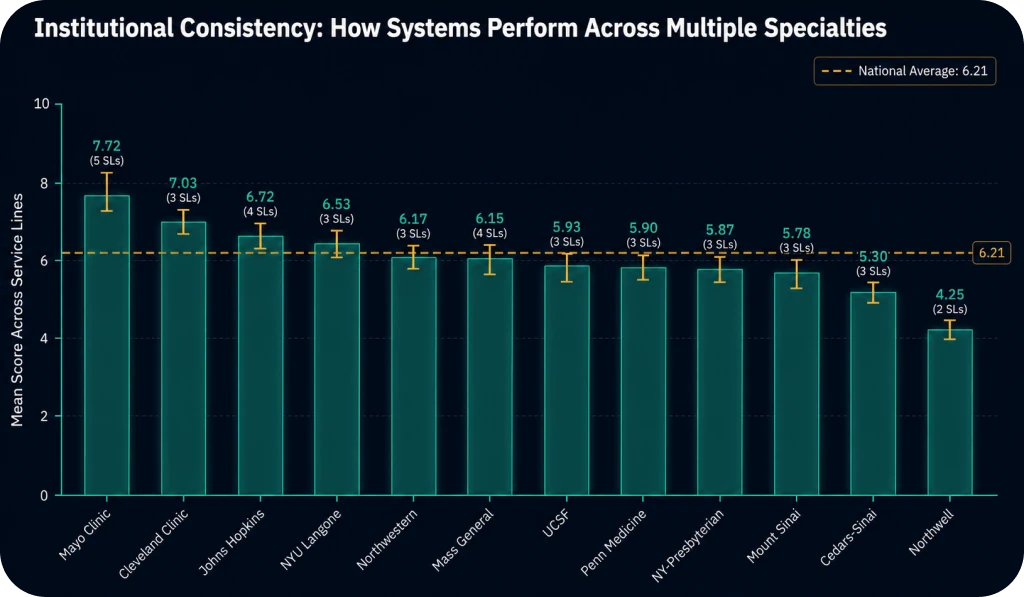
Many healthcare leaders assume that a strong clinical reputation naturally translates into digital visibility. The data suggests otherwise.
Organizations recognized for clinical excellence are not automatically recognized by AI systems as authoritative sources. AI platforms evaluate a wide range of signals, including content quality, data consistency, authority signals, and technical accessibility.
The organizations patients trust most are not always the organizations AI recommends most often. Clinical excellence and AI visibility are separate challenges.
Why This Matters to Revenue
Every patient who chooses a competitor because your organization was absent from an AI-generated recommendation represents a lost revenue opportunity.
For health systems, the impact can affect high-value service lines such as cardiology, orthopedics, oncology, neurosciences, and women's health.
For integrated delivery networks, AI visibility challenges can create referral leakage across facilities and service lines.
For specialty practices, the impact can be even more immediate, as larger competitors gain visibility while smaller organizations remain difficult for AI systems to recognize. The consequences compound over time.
The Visibility Gap Is Growing
AI search adoption continues to increase. Patients are becoming more comfortable asking AI systems for healthcare information, provider recommendations, and referral guidance.
Organizations that establish authority signals today improve their likelihood of appearing in future AI-generated recommendations. Organizations that ignore the shift risk becoming increasingly difficult for patients to find. The gap between visible organizations and invisible organizations is widening.
What Health Systems Should Do Next
Before developing any strategy, organizations need to understand how they currently appear in AI-generated healthcare recommendations.
That begins with measurement. Understanding where patient volume is at risk, which competitors are being recommended, and which visibility gaps exist provides the foundation for every future decision.
Without that diagnosis, optimization becomes guesswork.
Know Exactly Where You Stand Before AI Decides for You
The first step is understanding how your organization appears inside AI-generated healthcare recommendations, which competitors are being prioritized, and where patient volume may be at risk.
