Your Marketing Agency Is Solving the Wrong Problem

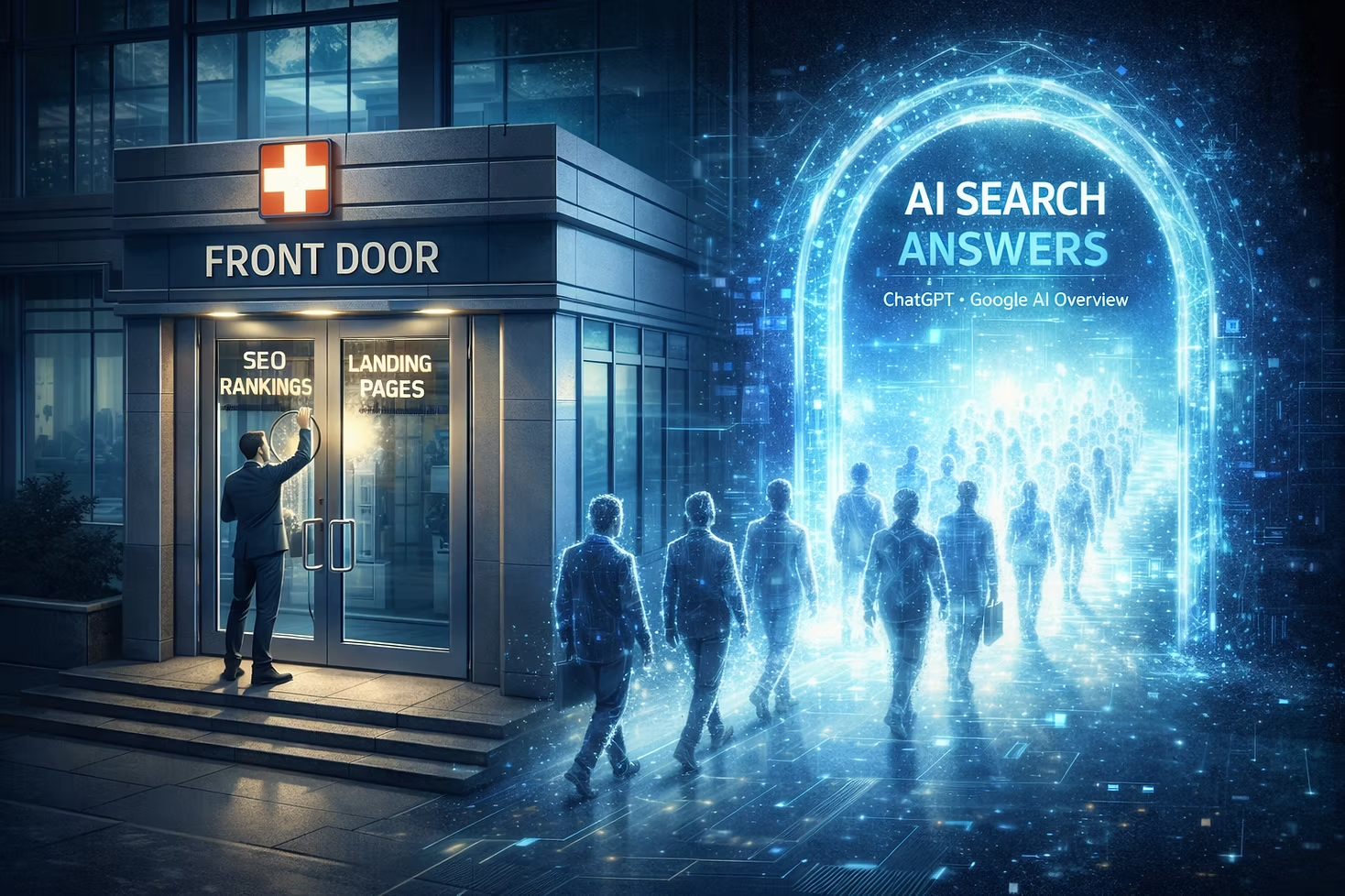
Your agency is doing everything right. That's the problem.
They're running faster ads, tightening landing pages, and pushing SEO rankings. Every metric in their dashboard looks fine. And yet you're losing patients. Not to a competitor down the street. To an AI model that answered a question before your website ever had a chance.
That's the gap no agency is talking about. And it's growing every quarter.
What Your Agency Reports vs. What's Actually Happening
Ask your agency how your health system is performing, and you'll get a clean slide deck. Website traffic is up. Cost per click is down. Conversion rates are improving. All true. All beside the point.
Here's what they're not showing you: a growing percentage of your highest-value patients never made it to your website at all. They asked ChatGPT, Google's AI Overview, or Perplexity which cardiologist to see, where to go for cancer treatment, or whether they should get a second opinion. AI answered them directly.
Those patients didn't bounce. They didn't convert poorly. They were never counted. That's the blind spot.
The Funnel Is Shrinking at the Top
Traditional healthcare marketing assumes patients start their journey with a search engine, land on your website, and move through a funnel toward an appointment. Your agency optimizes every step of that funnel. They're good at it.
But AI has inserted itself at the very top of that funnel. Before the search result. Before the click. Before the website visit. A patient asks an AI tool a question and gets a direct answer, often with a recommendation. If your health system isn't cited in that answer, you don't exist in that patient's decision.
Think of it this way: your agency is optimizing the front door of your building. AI just built a back door that bypasses the building entirely. No amount of landing page optimization fixes a problem that happens before the patient ever sees your website.
This Is a Financial Problem, Not a Marketing Problem
Agencies measure clicks, impressions, and bounce rates. Those metrics don't capture what you're actually losing.
A growing portion of patient volume is now influenced by AI-driven decisions. For a mid-size health system, that's not a rounding error. That's lost procedures. Lost admissions. Lost downstream revenue from patients who never came through your door because an AI pointed them somewhere else, or nowhere at all.
The CFO conversation is coming. It's better to get ahead of it with a strategy than to explain the volume drop after the fact.
What Your Agency Can't Fix
This is not a knock on your agency. They are solving the problem they were hired to solve. The challenge is that AI search disruption is upstream of everything they do.
AI models don't read your ads. They don't care about your click-through rate. They pull from structured data, authoritative content, and consistent digital signals to decide which health systems to recommend. If your content authority, schema markup, and AI citation visibility aren't optimized, you're invisible in the channel that is increasingly driving the first patient decision.
Your agency can't fix what they can't see. And most of them aren't looking at AI-generated answers as part of their reporting. That's not a criticism. It's a gap.
First Movers Will Own the Advantage
AI visibility is not like SEO, where hundreds of competitors can rank on the first page. AI models surface a short list. Often one or two names. The health systems that establish strong AI citation signals now will be harder to displace as these models mature.
Lock in that position today, and six months from now your competitors are noticing the gap. Twelve months from now, they're playing catch-up. Waiting is not a neutral choice. It's a compounding risk.
The health systems that move first will build a competitive advantage that is very difficult to close. That's not hyperbole. It's how search channel dynamics have played out every time a new patient discovery channel emerged.
The Question Every CMO Should Be Asking Right Now
Does anyone on your team know how your health system appears in AI-generated answers?
Not your website ranking. Not your ad impressions. Specifically: when a patient asks an AI tool which hospital to choose for cardiac care, or where to go for orthopedic surgery, does your health system show up? Are you being cited accurately? Are you being cited at all?
If no one on your team has the answer to that question, that's the gap. And it's growing every quarter while your agency optimizes a funnel that AI is quietly shrinking at the top.
Find Out Where You Stand
AI Health Strategist runs complimentary AI Readiness Scans for health systems and private practices. In 48 hours, you'll know exactly how your organization appears across the AI search tools your patients are already using.
Reach out to Matt Klein directly at matt.klein@aihealthstrategist.com or connect on LinkedIn to request your scan.
