Your Health System's AI Search Problem Is Probably Not What You Think It Is

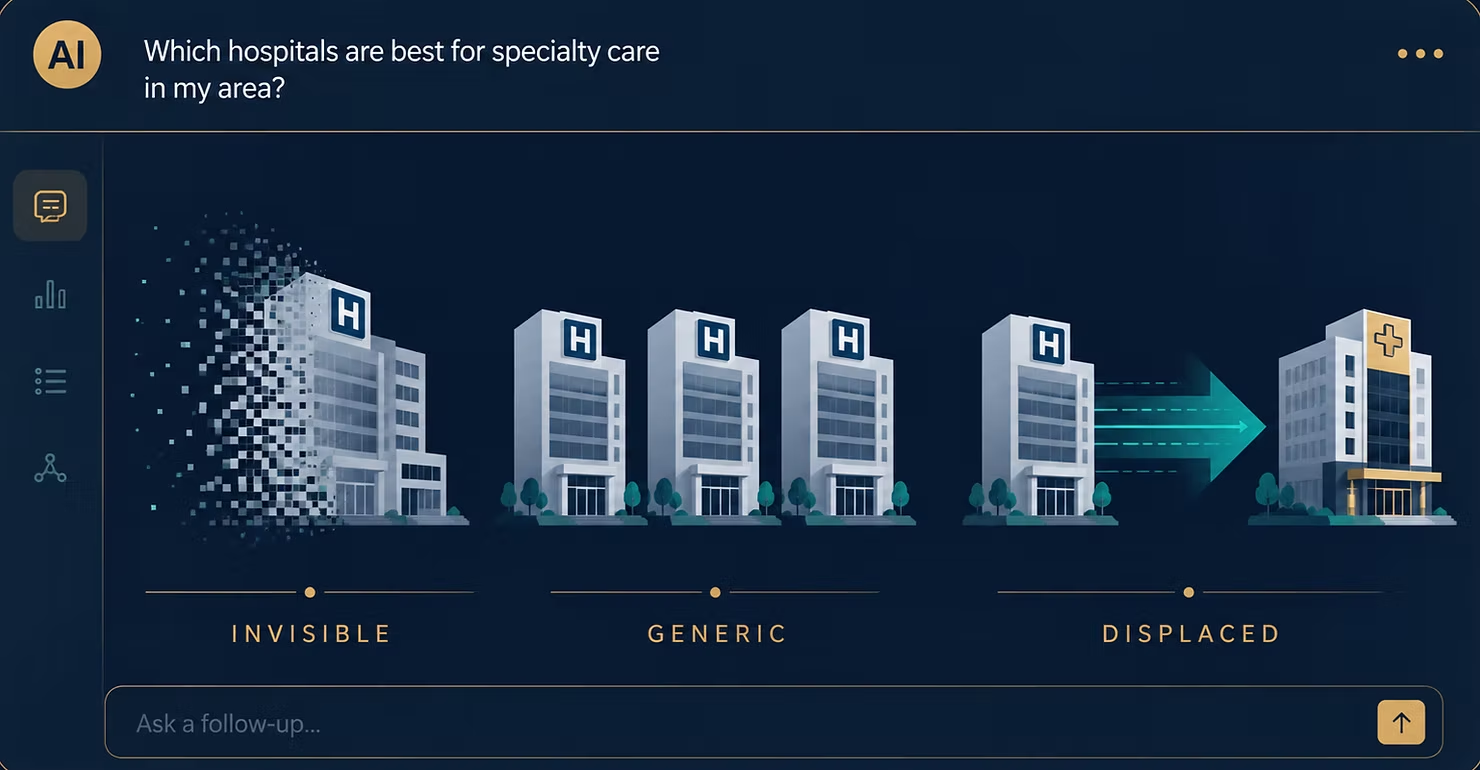
I've run structured AI query tests across dozens of health system service lines. The most common response I get from marketing leaders after seeing the results isn't a surprise. It's confusion. They assumed they had one problem. They find out they have three.
That confusion is expensive. Invisible, generic, and displaced are not the same problem; they don't have the same cause or the same fix. Most health systems treat all three as content problems and hand them to marketing to write more blog posts. That's the wrong prescription for at least two of the three.
Why the Diagnosis Matters More Than the Fix
Before ChatGPT and Perplexity became mainstream, the question was simple: where do you rank on Google? The fix was always some version of more content, more backlinks, better keywords.
AI search doesn't work that way. The platforms that now sit between your health system and your patients, ChatGPT, Perplexity, Google AI Overviews, Microsoft Copilot, and Claude, don't rank pages. They generate answers from sources they've determined are authoritative. By the time a patient reaches your website, they've often already made a shortlist inside an AI interface. If you're not in that answer, or if you're in it the wrong way, the website visit never happens.
The question your marketing team should be asking isn't "how do we rank better?" It's "which AI search problem do we actually have?" And right now, most health systems don't know the answer.
Failure Mode 1: Invisible
Invisible means AI has no usable content signal for your organization. When a patient queries "best orthopedic surgeons near [city]" or "top-rated cancer center in [region]," your health system isn't in the response. Not mentioned, not cited, not implied.
This happens for specific reasons. Missing or unstructured schema markup. Clinical content that isn't organized in a format that AI retrieval systems can parse. Weak or nonexistent presence across the sources AI platforms tend to cite. The problem is architectural, not cosmetic.
Invisible doesn't mean your website is bad. Your SEO might be solid. Your patient experience scores might be excellent. AI simply doesn't have the structured signal it needs to include you.
The fix is infrastructure: schema, structured clinical content, and authority signals built for machine consumption, not just human readers.
Failure Mode 2: Generic
Generic is more insidious than invisible, because it feels like progress when it isn't.
Generic means AI mentions your health system, but describes it in language that fits every competitor in your market. Your name appears. The description says something like "a regional health system offering a full range of services, including cardiology, orthopedics, and oncology." Three of your competitors could read that same description and nod along.
Research from LinkedIn's B2B Institute shows that buyers correctly attribute an ad to the right brand only 19 percent of the time when the creative is undifferentiated. The same attribution failure happens in AI-generated descriptions. A patient doing pre-visit research reads your AI description, reads two competitors' descriptions, and finds nothing to distinguish you. Interchangeable providers don't get chosen. They get dropped when the shortlist gets shorter.
More of the same content makes the generic problem worse, not better. The fix is differentiated clinical authority, specific outcomes data, and content that gives AI systems something attributable to say about you that can't be said about the hospital across town.
Failure Mode 3: Displaced
Displaced is the failure mode nobody is talking about. It's also the most urgent.
Displaced means AI is actively recommending a named competitor in response to queries that should belong to you. Not just ignoring you. Sending patients somewhere else, by name, in real time.
In one scan, we ran a query for "best orthopedic care near [city]" across three AI platforms, and it returned the name of a competing system repeatedly. Our client wasn't mentioned. The competitor wasn't better. It had better AI authority signals. That's it.
This is patient volume loss that doesn't appear in your referral tracking, CRM, or marketing dashboards. It happens upstream of every measurement system you have. And because nobody on your marketing team is running structured AI query tests monthly, the displacement compounds quietly.
The fix for displacement isn't more content or better SEO. It's a competitive response strategy, reoriented content architecture, and a measurement cadence that catches drift before it becomes a trend.
The Trust Tax: Why Reputation Doesn't Protect You
Here's the counterintuitive finding from our National AI Visibility Benchmark Study: the nationally recognized academic medical centers are not consistently winning in AI search. They're frequently being displaced by regional competitors with smaller reputations and better-structured content signals.
We call this the Trust Tax. AI systems cite what they can find and structure, not what they should know. Clinical prestige doesn't transfer into AI retrieval. Your decades of outcomes data, your awards, your U.S. News rankings, none of it appears in an AI response unless you've built the content architecture that puts it there in a format AI can use.
The national mean AI visibility score across the 50 programs in our benchmark study is 6.21 out of 10. No health system has locked this down. The organizations pulling ahead right now aren't the most prestigious. They're the most structured.
How to Diagnose Which Problem You Have
Run this test across your top two or three service lines. It takes about 20 minutes and will tell you more about your AI search position than a year of Google Analytics data.
For each service line, run these five query types in ChatGPT, Perplexity, Google AI Overviews, Microsoft Copilot, and Claude:
- Your organization's name alone
- Your service line plus your market ("orthopedic surgery [city]")
- The specific condition or procedure your patients search for
- A comparison query ("[your org] vs. [main competitor]")
- A patient-language query ("best [service line] near me [city]")
For each result, document four things: whether you appear at all, how specifically you're described, whether your actual differentiators come through, and whether a competitor is named instead of or ahead of you.
The pattern tells you which problem you have. Absent entirely: invisible. Present but vague: generic. Competitor named where you should be: displaced. A single service line scan can return all three failure modes across different queries, which is exactly what makes this hard to treat as a single problem.
The Fix Starts With Knowing What You're Fixing
I've watched health system marketing teams spend six figures on content programs that made a generic problem worse. I've watched SEO investments fail to move the needle on AI visibility because SEO and AEO are different optimization targets with distinct content requirements. And I've watched displaced health systems lose patient volume they'll never fully account for because they didn't know the displacement was happening.
The solution isn't a new agency relationship or a bigger content budget. It starts with an honest diagnostic across your top service lines on all five major AI platforms.
If you don't know which problem you have, you're not ready to fix it yet.
Get Your Complimentary AI Readiness Scan
We'll show you exactly where your health system stands across ChatGPT, Perplexity, Google AI Overviews, Microsoft Copilot, and Claude, scored across five dimensions, with revenue at risk quantified by service line.
Contact: jeff.montgomery@aihealthstrategist.com
